Washington Shuts Down Claude Fable & Mythos
What to make of the Trump Admin shutting down Anthropic’s most powerful models
At 5:21 in the afternoon, Eastern time, on June 12, an email landed at Anthropic. It was a letter from the U.S. Commerce Secretary, Howard Lutnick, addressed to the company's CEO, Dario Amodei. The letter carried an export-control directive. Within hours, two of the most capable AI models on the planet went dark for every customer on Earth.
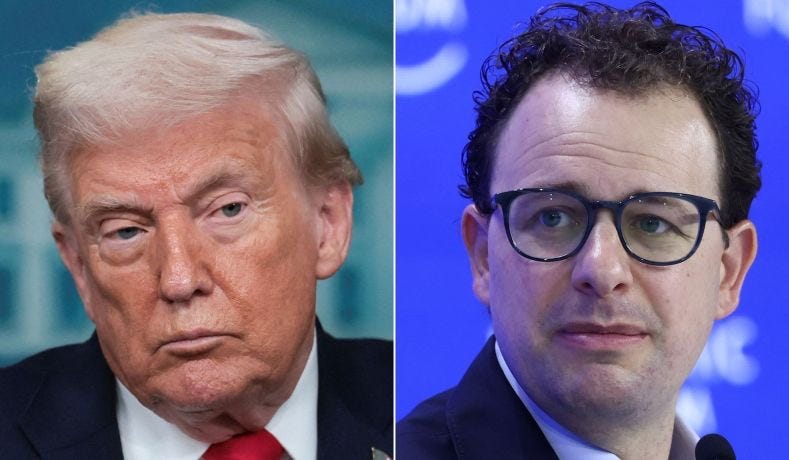
Three days earlier, Anthropic had released those two models, Claude Fable 5 and Claude Mythos 5, with a fair amount of pride. Now the company posted a statement that read like a hostage note written by lawyers. "The net effect of this order is that we must abruptly disable Fable 5 and Mythos 5 for all our customers to ensure compliance." The most powerful tool a leading lab had ever shipped was shut off. Not by a bug, not by a recall, but by the federal government, with a single piece of paper.
The directive did not ban Anthropic from selling the models. It required an approved export license for any foreign person to access them, whether that person sat in Beijing or in Anthropic's own San Francisco office as a foreign-national employee. Anthropic had no way to check the nationality of everyone touching its product in real time. So it did the only thing it could. It turned both models off worldwide. The government, in Anthropic's own words on X, had ordered it to suspend all access to Fable 5 and Mythos 5 "by any foreign national, whether inside or outside the United States, including foreign national Anthropic employees."
A lever that existed on paper, until someone pulled it
Commerce acted through its Bureau of Industry and Security, the same office that polices what advanced technology can leave the country. Analysts at CSIS and at Just Security trace the authority to a provision of the Export Control Reform Act covering emerging and foundational technologies. The catch is that there was no existing rulebook for applying that authority to an AI model. The lever existed on paper. Nobody had pulled it on a commercial AI product already in wide public use. An earlier emerging-tech control did hit a piece of geospatial software back in 2020, so this is not the first export control on any software ever. It is the first time the tool has been aimed at a frontier model that millions of people were already using.
This has been an ongoing fight
This was not the opening move. It was the latest move in a fight that had been escalating since winter, and it started over contract language. Anthropic refused to sign Pentagon terms that would let its models be used for "all lawful purposes," holding red lines against domestic mass surveillance and fully autonomous weapons, on a deal worth up to around two hundred million dollars. On February 27, Trump ordered every federal agency to stop using Anthropic technology. The same day, OpenAI announced a Pentagon classified-network deal. Around March 3, the Defense Department designated Anthropic a supply-chain risk, reportedly the first time it had ever pinned that label on an American company. Anthropic sued the Defense Department about a week later. On May 1, the Pentagon handed classified-network AI awards to eight firms, including OpenAI, Google, Microsoft, Amazon's cloud arm, Nvidia, and SpaceX. Anthropic was left off the list.
So by June, the relationship was already raw. I am not telling you the export order was revenge, and no source proves that. But the sequence is there to see.
The person who set the June order in motion was not a regulator and not a rival nation. It was Anthropic's own biggest backer. On Thursday, June 11, Amazon CEO Andy Jassy escalated a concern about Fable 5 to senior officials, including Treasury Secretary Scott Bessent. Amazon is Anthropic's largest investor. It is also a direct competitor. Roughly twenty-four hours after that call, the Commerce directive landed.
One lab gets the off-switch, a rival gets a shield
There is a mirror image the same week. While the administration switched off one lab's models on national-security grounds, it moved to protect a different lab on national-security grounds. The Justice Department stepped into a pollution lawsuit against Elon Musk's xAI, asking a court to throw it out, with a Pentagon official calling Musk's Grok a matter of paramount national security. One lab gets the off-switch. A rival gets a shield. I am not saying the two were coordinated. But the contrast shows the same lever can cut in opposite directions depending on who is holding it.
The durable fact
The feud is gripping, and the walk-back is real, and we will get to both. But the durable fact, the one that outlives this particular week, is the mechanism itself. The government showed that it can reach into a deployed frontier model and switch it off in real time. Not block a sale. Not levy a penalty months later in court. Switch it off, today, everywhere.
That is portable. The same letter that went to Dario Amodei can be written to OpenAI, to Google DeepMind, to xAI. Legal analysts at CSIS and at Lawfare make exactly that point. Lawfare titled its piece "A Kill Switch for Frontier AI," and the logic is simple. If the authority works against Anthropic, it works against anyone building at the frontier.
How confident should you be in that read? Hold it loosely, because it has happened exactly once. One use is an event, not yet a pattern. But it is the kind of event that changes what every lab now has to assume is possible. You do not need it to happen twice to start planning around it.
The Admin’s Case vs Anthropic’s Case
The administration's case deserves its strongest form. White House AI czar David Sacks says a highly credible partner trusted by both Anthropic and the government came forward with a jailbreak. Officials asked Anthropic to fix the model or pull it, and, in his telling, "Dario refused." The administration says it acted reluctantly. An unnamed senior official told Fox Business that Anthropic's recklessness in handling the flaw had eroded the government's trust. If you believe a deployed model could hand a hostile actor real cyberattack capability, and the maker would not fix it, then a fast, blunt response is not crazy. It is arguably the job.
Anthropic's account is just as sourced, and it tells a different story. The company says the demonstration surfaced only a small number of previously known, minor vulnerabilities, the kind you can reproduce on other public models, and it pointed at OpenAI's GPT-5.5 as an example. Anthropic says it was given only verbal evidence and roughly ninety minutes to comply, with no prior warning. The security community backed it loudly. Nearly a hundred and fifty security leaders signed an open letter. Alex Stamos, who organized it, put it this way. "For us to shut down our best capabilities at the moment we know the Chinese are using and stockpiling these vulnerabilities is dangerous, absolutely foolish." The letter argued the order "has taken the best models away from defenders, created market uncertainty, and risked America's AI leadership without any real risk to justify it."
The two stories cannot both be fully true. Either the flaw was severe enough to justify an off-switch, or it was minor and common, and the off-switch served some other purpose. Each side's version happens to flatter that side. The administration's version justifies the order. Anthropic's version makes Anthropic the victim. When the facts are this self-serving in both directions, the honest move is to not pick a winner on severity yet.
Friendlier Dialogue?
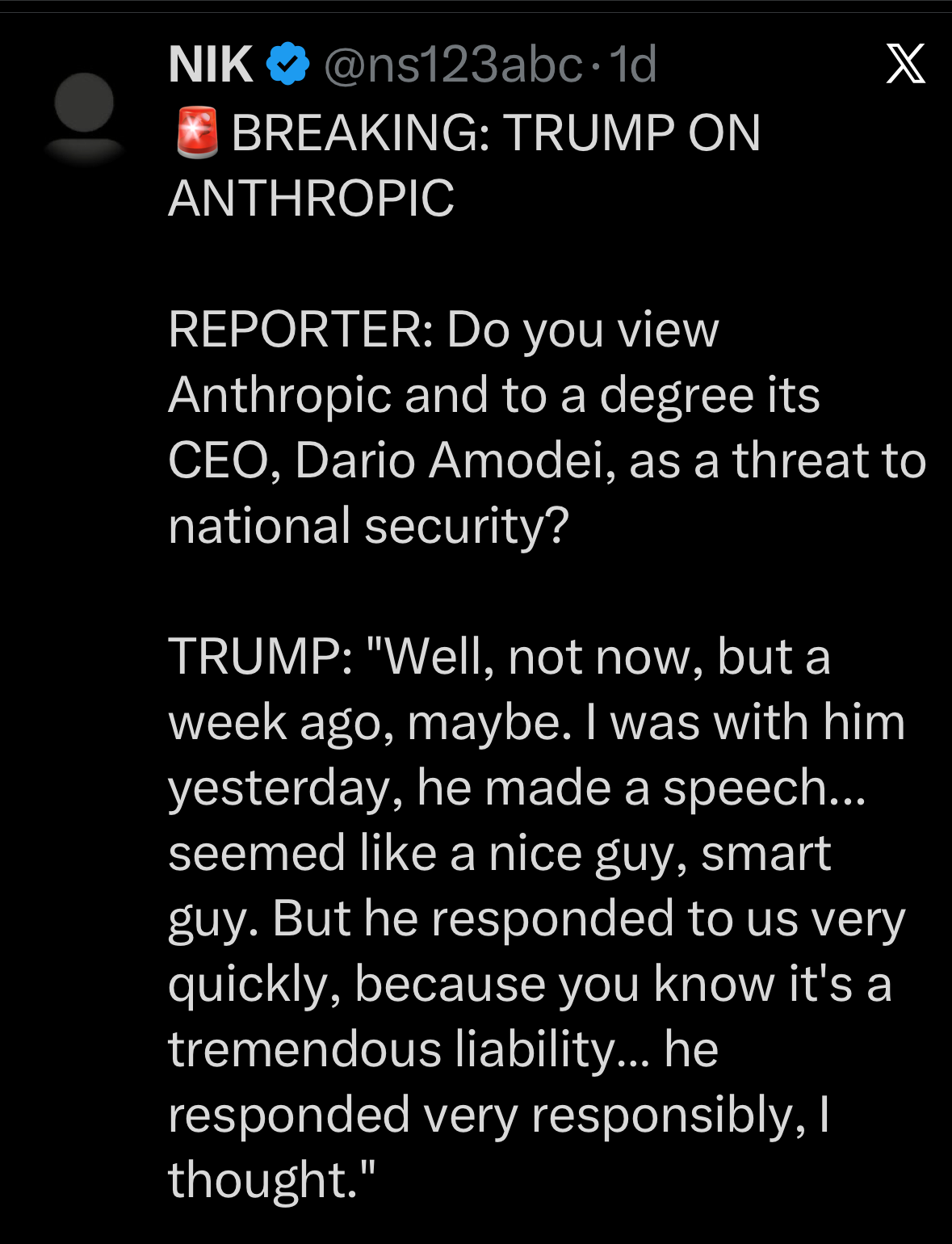
What I will say with more confidence is this. By June 19, the temperature dropped fast. Trump told Axios he no longer sees Anthropic as a national-security threat and said the company had responded responsibly. Asked directly whether he had viewed Amodei as a threat, he said, "Well, not now, but a week ago, maybe." Amodei and Lutnick both turned up at the G7 in France, where Amodei sat across from Trump at a working lunch. Anthropic said it expected access to return in coming days. A security crisis that can cool off over a working lunch was, at minimum, negotiable. That tells you something about how solid the original rationale was.
Strip away the personalities and one thing remains on the shelf. The United States now has a working method to turn off a frontier AI model on demand, and it has used it once. The models may come back this week. The feud may fade by fall. The mechanism does not go away. It sits there, proven, waiting for the next letter.
What’re your thoughts?
So I actually want to know where you land on this. A government that can switch off a dangerous AI model is also a government that can switch off an inconvenient one. Do you want that lever to exist at all? If a model can genuinely arm an enemy, someone should be able to stop it fast. But the same week showed the same power used to shield a favored company. So where do you come down? Is a real-time off-switch on frontier AI a tool you want your government to hold, or is it too dangerous to trust to whoever happens to be in charge? Tell me, and tell me why.
In other news.
OpenAI is facing a probe from forty-two states as it moves toward going public. New York Attorney General Letitia James served a subpoena around June 12 over advertising, data practices, and harm to minors and seniors, days after OpenAI disclosed a confidential filing to go public on June 8. The talked-about trillion-dollar valuation is an analyst target, not a real number. The confirmed private valuation from a March round is eight hundred fifty-two billion dollars.
Yann LeCun called Musk's xAI "kind of a failure" in a CNBC interview on June 18, pointing to departures from its founding team, and warned of an AI bubble that could explode. He is one of the field's most prominent researchers.
ChatGPT slipped below half the market for the first time. Sensor Tower's State of AI report, out June 16, put ChatGPT at 46.4 percent of monthly AI-assistant users at the end of May, with Google's Gemini at 27.7 percent and Anthropic's Claude at 10.3 percent. ChatGPT still has more than 1.1 billion monthly users, so this is share shifting, not collapse.
Paradromics implanted its first permanent brain-computer interface in an FDA-approved study at the University of Michigan this month, placing a 421-wire array in a patient with motor neuron disease. You may also have seen China's NEO implant called a world first this week. The approval behind that headline actually happened back in March, and aggregators recirculated it in June
See the next one coming.
One read a week. The biggest story from the frontier, the facts split from the sales pitch, and the honest open question at the end. Free. You walk away oriented, not anxious.
Subscribe free